
by Jason Hicks
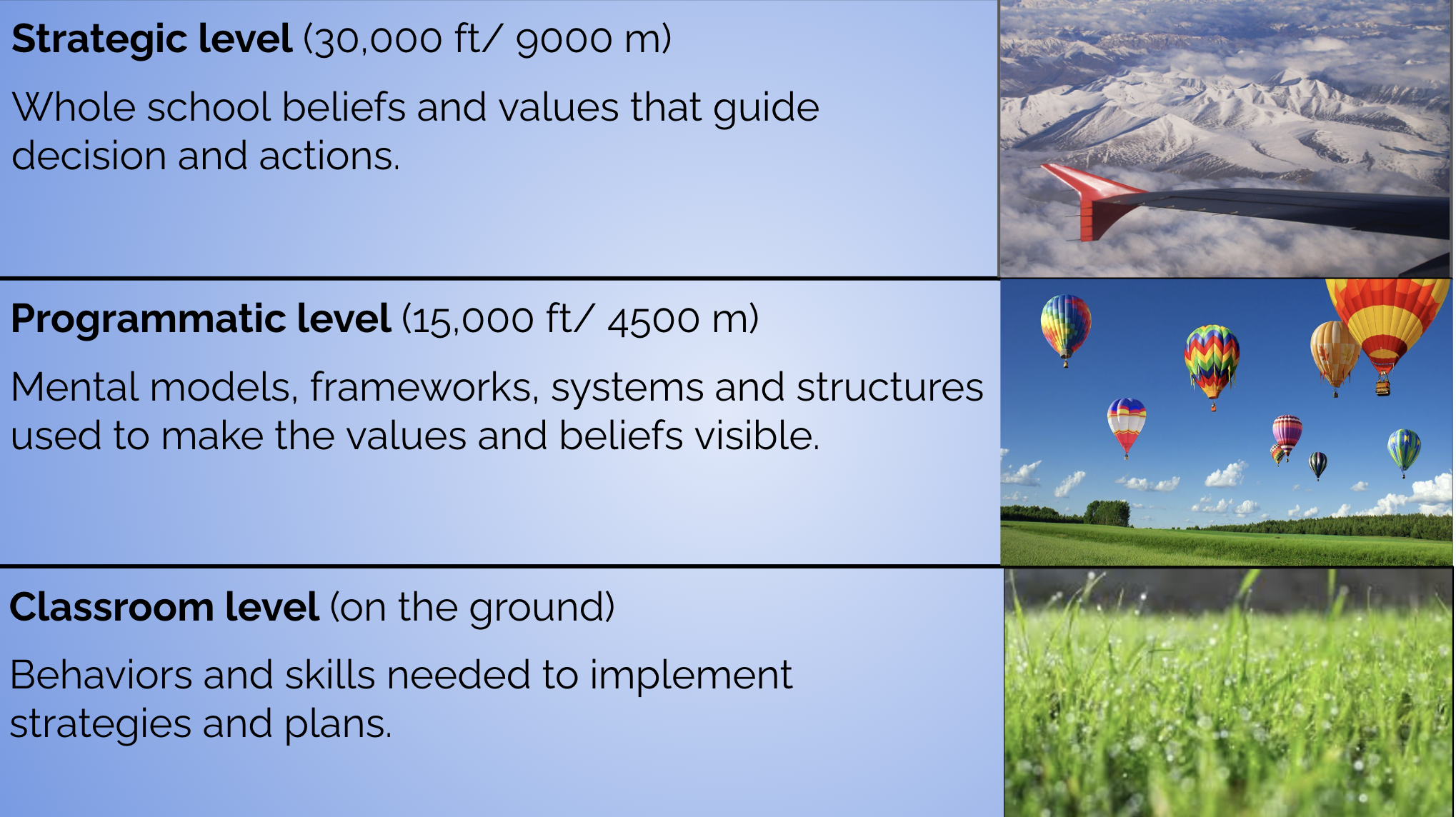
Schools are meant to be places of belonging, communities where student agency and teacher efficacy thrive. But moving from vision to action is rarely straightforward. The complexity of school culture and systems requires attention at multiple levels: beliefs at 30,000 feet, programming at 15,000 feet, and classroom practice on the ground.
Too often, leaders debate whether mindsets must shift before skill sets can be developed. The truth is that meaningful change depends on both, simultaneously and intentionally, anchored by a coherent theory of action. Without it, schools risk false starts and fractured implementation. A mission statement may be widely known, but when programming is underdeveloped and processes are unclear, aspirations remain just that. Practices become inconsistent: one teacher designs inclusive lessons for the full range of learners, while another routinely sends students elsewhere (to a learning support teacher, for example) because they “can’t keep pace.” These disconnects are not about individual effort, but about systems that fail to align vision with practice.
Barriers in Design, Not Deficits in People
Progress depends on recognizing that barriers to implementation are rooted in the design of the change process, not in the people we lead. Teachers, like students, are at various stages in their educational journey. Meeting them where they are, while honoring their expertise, builds trust and models the very mindset we want reflected in classrooms.
The challenge for leaders is to ask the “just-right” next question: one that nudges growth without overwhelming. Misalignment often occurs when leaders, who are further along in their own learning, pose questions their teams are not yet ready to answer. That gap is where frustration builds and momentum falters.
When systems and structures are not clearly defined, people will improvise with well-intended solutions in the moment. The result is inconsistency and inefficiency. Suppose we want those lofty beliefs at 30,000 feet to take root in classrooms. In that case, the middle layer of programming and processes must be documented, explicitly explained, and revisited so that they are used with fidelity.
Surfacing Dissatisfaction as a Catalyst
Ken Posner’s Theory of Conceptual Change highlights that people are more likely to shift their practice when they discover their own dissatisfaction, rather than having it pointed out by others. Most educators want to do better. Harnessing that intrinsic motivation is often the most potent driver of change. So, how do we design to surface dissatisfaction and turn that into action? Here is one strategy.
The 15 Minute Learning Hit
One practical strategy is to dedicate 15 minutes of a faculty meeting to a focused “learning hit”:
- Connect to values (1 minute)
Reinforce how inclusive education already aligns with the school’s guiding principles and/or core beliefs. For example:- There is no such thing as an average learner.
- Learner variability is normal and predictable.
- Each of us has a unique, jagged learning profile.
- Show a short video (3 minutes)
For instance, The 7–10 Split by Shelley Moore. - Facilitated table talk (5 minutes)
Prompts might include:- What resonated with you?
- How does this align with what you see in your classes?
- How might designing for variability make a difference here?
- Invite share-outs (3 minutes)
Ask one or two tables to highlight their takeaways. - Reflect and Exit (3 minutes)
As you wrap up the Learning Hit, collect some feedback by using the strategy Most Important Point (MIP). Simply ask everyone to reflect and record the MIP on a sticky note and leave it at the table.
- Follow up intentionally. Informally, over the next 2 days, senior leadership, associate principals, coaches, or teacher leaders can check in with some staff to gauge how the discussion resonated. Share these insights at the next leadership team meeting and consider next steps: What further provocations or learning could help teachers evolve their beliefs and shift their practice? Identify early adopters who can champion the work as the school refines systems of belonging. Keep revisiting that action plan, celebrating the short-term wins, and generating momentum.
Build Collective Efficacy
One of the best lessons I’ve learned is that educators value time to wrestle with meaningful ideas alongside peers. Fundamental shifts often come not from launching another acronym-heavy initiative or top-down directive, but from reflective, rapport-filled conversations that surface authentic questions and insights. Continue revisiting that action plan, celebrating the short-term wins, and generating momentum so that everyday practice reflects the vision.
Written by Jason Hicks
At Pathways to Inclusive Education, we partner with schools and leadership teams to navigate the complexity of change. If you’d like a complimentary conversation about inclusive practices, Multi-Tiered Systems of Support, Universal Design for Learning, or another problem of practice, contact us at pathwaystoinclusiveeducation@gmail.com or visit www.pathwaystoinclusiveeducation.com.
Leave a Reply